Integrative Team Coach Training
This program is for practicing helping professionals who want to guide whole teams toward their shared goals, from diagnosis to closure. Over nine days, we provide a range of methods, a place to practice and live client work supported by supervision.
- When does it start?
- from September 29, 2026
- Participation fee
- from HUF 720,000 + VAT
Solution Focus
Licensed / external methodologyA solution-focused approach: instead of analyzing the problem, it works toward the desired state.
- One of the methodological pillars of the Integrative Coach Training and the Integrative Team Coach Training
The solution-focused approach (Solution Focus) directs attention to the desired future and to the solutions that already work, rather than to analyzing problems. Its core questions are about goals, exceptions and small steps: when does it already work better, and what would it take for it to work that way more often? Its tools, such as scaling, the miracle question and resource exploration, can be used in individual coaching and with teams alike; in team coaching, the Solution Circle provides a framework for exploring the team's shared goals and resources. It is one of the methodological pillars of GROW's Integrative Coach Training and a standalone module of the Integrative Team Coach Training.
Related programs: Integrative Coach Training · Integrative Team Coach Training
Gestalt
Licensed / external methodologyPresence in the here and now: working consciously with blocks and contradictions.
- Builds deeper emotional awareness and self-awareness
- Works by recognizing one's own and others' subjective view of reality
The Gestalt approach is built on the here and now: on what is happening in the present, in the room, and on how a person relates to themselves, to others and to their environment. Its main tools are awareness, contact and experimentation: through clear observations and feedback, participants recognize the patterns in how they function and where they get stuck, and try out new ways of operating within a safe framework. In team coaching, Gestalt interventions focus on the team's forms of connection, polarities, subsystems and peripheries. It is a methodological pillar of GROW's Integrative Coach Training and a two-day module of the Integrative Team Coach Training, and we also run it as a standalone self-awareness training.
Related programs: Gestalt-Based Self-Awareness · Integrative Coach Training · Integrative Team Coach Training
What is the program about?
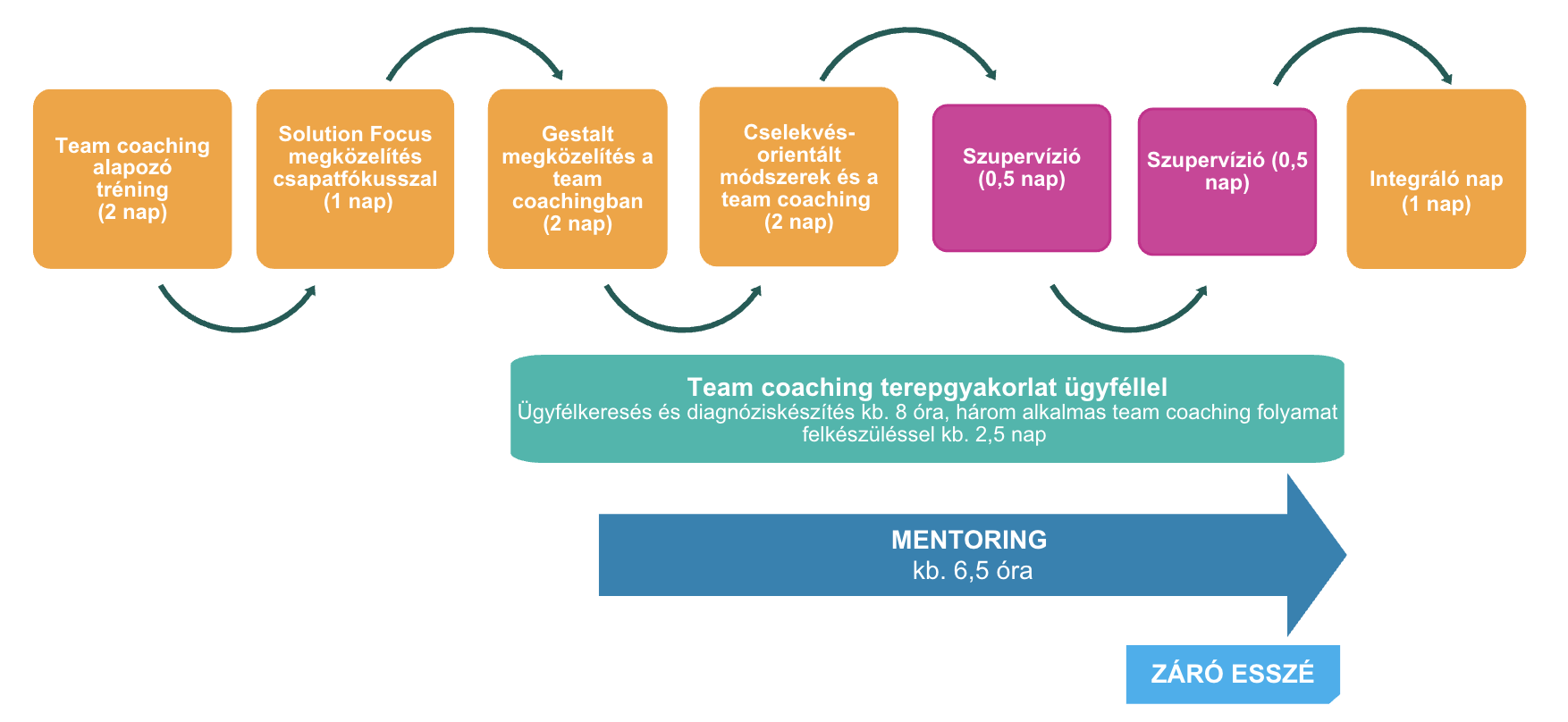
9 days in 5 modules, with real client work, supervision and mentoring between modules; methodologically grounded in Solution Focus and Gestalt.
Team coaching works with how the team functions as a whole: with its patterns of collaboration, decision-making and shared responsibility, rather than with individual development in a group format. This is also what sets it apart from team building and from workshops. It is a process of several sessions in which the coach does not hand out solutions but uses questions and reflective dialogue to help the team recognize and shape the way it works. Its strength lies in always working with what is actually present in the team's current functioning.
What you take away: a marketable team coaching toolkit: a methodology for leading the process from diagnosis to closure; more confident handling of group dynamics, partly from your own experience; experience of live client work with supervision and mentoring.
Who is the program for?
For practicing coaches and coach training graduates, including graduates of the foundation or advanced level of GROW's Integrative Coach Training, and for professionals who work with groups: trainers, facilitators and moderators. HR professionals and leaders who want to support how their teams work more systematically also join. The entry requirement is completion of a coach training program of at least 60 hours and at least 30 hours of coaching practice.
When is it worth starting?
- as a practicing coach, you want to expand your toolkit toward team coaching
- as a trainer or facilitator, you need to take your team development methodology deeper
- as an HR professional or leader, you need methods and practice to support how teams work.
How we work
The program is 70 percent practice, and the group itself experiences, as a learning team, the very group dynamics it is learning about. Alongside Solution Focus and Gestalt, we also teach a version of action-oriented techniques tailored to team coaching.
Between modules, participants work with their clients in mini team coach teams. The entry requirement is at least 60 hours of coach training and 30 hours of individual coaching practice; applicants who did not train at GROW apply with a motivation essay. The program concludes with a self-reflection essay in which participants look back on their own client work and on what they recognized during supervision.
GROW's approach to team coaching
An organization's performance is the sum of how its individuals and teams work, so it is crucial that the connections, collaboration, values and working patterns within teams support the achievement of shared goals. Team coaching focuses on this level: the deliberate development of how a closely collaborating team that takes responsibility for a shared goal functions, such as a leadership team, a project team or an organizational unit. It provides a safe space for speaking openly and for difficult topics, while the focus always stays on learning and on agreements that support progress, and it supports uncovering resources, the quality of collaboration and more effective team performance all at once.
Module structure
- Module 1, foundation training (2 days): the place of team coaching in organizational development; the process and stages of team coaching; the methodological elements, exercises and theoretical frameworks linked to each stage; group dynamics; interventions in team coaching.
- Module 2, the Solution Focus approach with a team focus (1 day): how the core values of SF appear in team coaching and how to use them; applying the Solution Circle; practice.
- Module 3, the Gestalt approach in team coaching (2 days): Gestalt interventions; clean observations and feedback in the team coach role; forms of contact and types of dysfunction in the team; working with polarities, subsystems and peripheries.
- Module 4, action-oriented team coaching (2 days): individual, interpersonal and team-level action-oriented methods; attuning the team and warming it up to the topic; action-oriented sociometric tools and other techniques; practice.
- Module 5, integration day (1 day): reflection and self-reflection on what was learned in the process and on the team coach role; summary and closure.
Training days run from 9:00 a.m. to 5:00 p.m., and the two supervision half-days from 9:00 a.m. to 12:30 p.m.
An integrative approach
At GROW, we believe there is no single method or approach that fits every situation. That is why, alongside Solution Focus and Gestalt, participants also learn dramatic techniques and creative exercises, so they can choose the right method for the situation at hand. Over the eight training days, they gain solid knowledge and get to know numerous models and frameworks, which they try out through their own experience or in exercises and can start using right away.
Client work with supervision and mentoring support
During the client work, participants try out the methods they have learned and experience a team's dynamics and the effect of their own interventions. The program offers two supervision sessions for working through dilemmas and questions, and each team can draw on three mentoring sessions during the training period.
How to apply and how the program concludes
To apply, along with proof of your coaching practice and coach training, we ask for a motivation letter of about one page that gives us a picture of your professional background, your coaching approach and your ideas about team coaching. In the closing self-reflection essay, participants reflect on their experiences from the client work and the insights they gained during the training and supervision, and summarize their experiences and ambitions related to the team coach role.
Participants receive a certificate on completing the program.
Venue and contact
Venue: GROW Training Room, 1037 Budapest, Montevideo u. 3/A.
If you have questions or would like to apply, contact Sándor Orsolya: +36 20 207 0425, sandor.orsolya@grow-group.com
Participation fee
HUF 910,000 + VAT per person. For private individuals: HUF 720,000 + VAT per person.